Showing posts with label cheeks. Show all posts

Monday, 3 November 2014

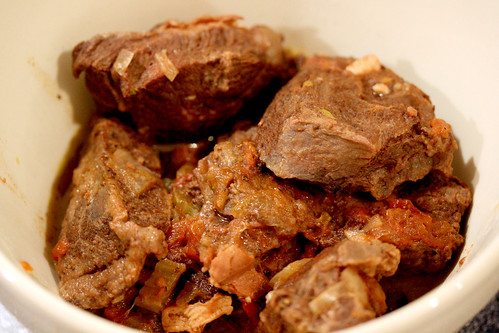
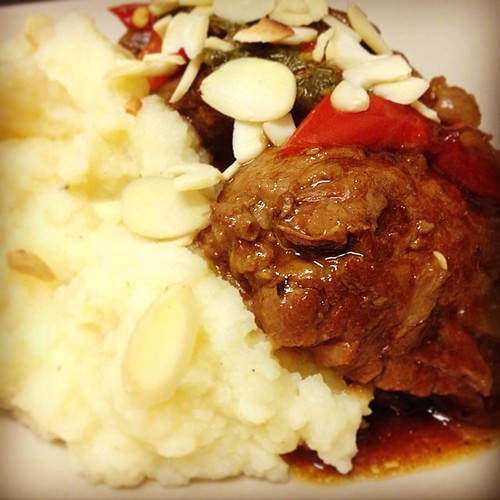
Sherry Addled Spanish Pigs' Cheeks

Pigs cheeks in their sticky sherry sauce again for night 2 of our foray into restauranting @themoveablefeastpopup

Pork and sherry is a fine combination. Especially when the sherry is sweet and the pork falls apart like a sous vide ponzi scheme. The sweetness of the pork is exaggerated and at once tempered by the oleaginous lusciousness of the sherry. And even more so as it reduces with onions and a touch of paprika. It would be lazy to say it tastes of Spain. But maybe Spain tastes of it. It becomes syrupy and, whilst sweet, also savoury and deep. A bit like a grandfather telling a long story full of unnecessary details and the occasional sentimental Catherine wheel of warmth.

So when Cowie and I were planning our main course for our pop up we found that pigs cheeks cooked in sherry was at the top of our list. It needed to be something that could be cooked in advance and reheated. Something where the prep was done way in advance and the flavours could mature. Something luxurious and generous, but not flashy.

In order to feed 60 we ordered 200 pigs’ cheeks from Kimber’s near Wincaton. Their first class farm shop is responsible for us acquiring a chest freezer for our house in London. Whenever we go down to Somerset we always seem to come away with unusual cuts of fabulous meat. We can’t recommend them enough and pretty much live off their pork rissoles have a serious soft spot for their goose skirt and Jacob’s Ladder.

We decided to slow cook the pigs’ cheeks in a mixture of medium dry sherry and Pedro Ximinex sherry along with a large quantity of caremelised onions which had been given a warm bath in sherry as well. Aside from some seasoning and a touch of paprika and garlic all they needed was a good searing and then a long burble in the sherry.

Served on their own, they would be in danger of being a bit too deep, so a gremolata made with lemon zest, lemon juice, olive oil and parsley brings them to life. And some toasted almonds bring out the nutty notes of the pork and savory nature of the sherry. They also add a nice bit of crunch.

The secret is to strain off the sherry liquor once the cheeks are cooked and to reduce it to a sticky sauce, brightened up with sherry vinegar as you see fit. Taste it regularly as you reduce it so you balance the acidity and the sweetness. It really is a killer sauce and if you have too much you can use it as a fabulous sauce with game. We had it with some grouse recently and loved it. Likewise it would grace a bavette or a haunch of venison. Guard it. And admire the way it sets to a wobbly dark brown jelly. It’s not looker.

Celeriac mash and some greens is all you need to go with this. Enjoy it. It’s our favourite dish.

Ingredients to feed 4

12 pigs cheeks with the membrane removed (Allow 3 cheeks per person. You just want the nugget of meat that butchers sometimes call the pillow)
Flour to dust cheeks
10 onions
4 cloves of chopped garlic (smoked would be extra nice)
1 bottle of medium dry sherry
200ml of Pedro Ximinez sherry
(Prunes, dried figs and dates are all nice optional extras)
Sherry vinegar to taste
1 celeriac
1 teaspoon smoked paprika
200g potatoes
100g toasted almonds
Courgettes
Salt and pepper

Method

Season the flour and dust the cheeks.

Sear the cheeks in a hot pan with a good slug of olive oil. Do this in batches. And if they catch loosen them with some of the medium dry sherry. Add this to the slow cooker.

Then fry the onions slowly until they caramelise. At this point add the garlic and smoked paprika. Add PX sherry towards the end of the frying. Add this to the slow cooker.

Pour over as much sherry as is needed to cover the pigs cheeks. Add 2 bay leaves. Grind in some pepper.

Leave to slow cook for 3 to 4 hours – or until the cheeks are cooked. You want them to retain their shape and not go mushy.

At this stage, make some celeriac and potato mash, steam some courgettes or greens.

Also, make a gremolata. Zest 2 lemons. Finely chop 100g parsley. Squeeze two lemons into a bowl with the first two ingredients. Add salt. Add pepper. Glug in some olive oil. Stir. Taste. You want it to taste as sharp and clean as a Japanese knife. It should have almost metallic cleanliness to it that sets off the dark, unctuousness of the pork and sherry.

When the cheeks are cooked strain off the liquor. Add it to a large saucepan and reduce aggressively. Stir. And taste frequently. Add a good splash of sherry vinegar to add some acidity and life to the sauce. This stops it getting too heavy.

You will need to reduce for some time. The stickier the sauce is the better. When it is nice and syrupy take it off the heat and put it in a jug.

Serve with the mash, and veg with 3 cheeks covered in sherry sauce. Then slurp over a spoonful of vibrant gremolata and scatter over some toasted almonds.
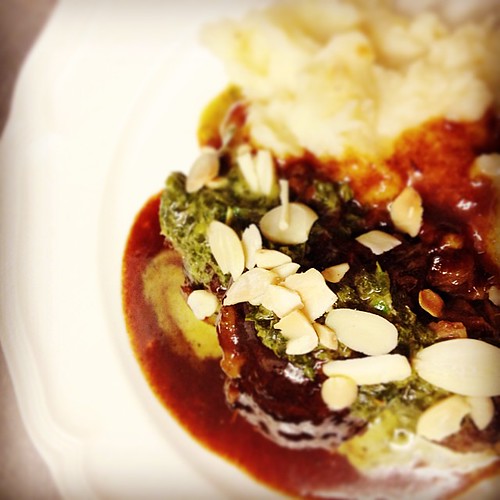
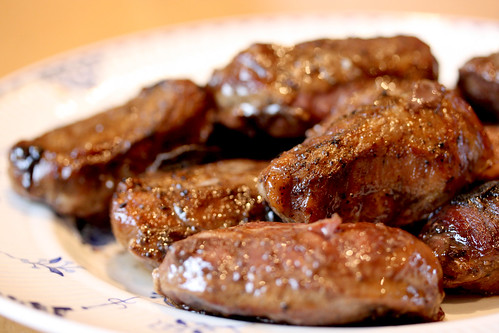
Pigs cheeks in a sticky PX sherry sauce with gremolata, toasted almonds and celeriac mash @themoveablefeastpopup

Thursday, 11 February 2010

Ox Cheek Open Ravioli

If I was to pick two things that get me excited in the kitchen at the moment it would be cheeks and Waitrose’s “Forgotten Cuts” range of slightly leftfield meat. My recent experiments with pigs cheeks as sausage rolls, piggy Wellingtons and covered in a bourbon and mustard glaze were a thrilling success. So I thought I’d graduate on to ox cheeks.


Ox cheeks are pretty hard to get hold of. Because of BSE they were banned along with other meat from around the head and cuts on the bone. And since then it has been consistently difficult to find them. After a quick trawl of eGullet the picture became clearer. Restaurants and butchers find it hard “to get head” because the head is not allowed to leave the abattoir owing to the rules that are designed to protect the public from being exposed to the brainy bits that are linked to BSE/CJD. And even if butchers do manage “to get head” they have to have a vet present whilst they do what they do.

Despite all this you can buy expensive ox cheeks from the likes of Donald Russell, but it’s much more convenient and cheaper to pick some up from Waitrose where two hefty cheeks will set you back a meagre 4 or 5 quid.

The beauty of ox cheeks doesn’t lie in the eye of the beholder. They are ugly brutes which have spent their working life grinding their way through grass. The meat is dense. To slice through a cheek makes even the sharpest knife feel a bit James Blunt. Through the centre of the cheek runs a seam of fat and connective tissue. Like the band of gold that sits below Johannesburg, this is the where the true joy of ox cheeks lies. When cooked slowly this seam, as if by alchemy, turns to a gelatinous, unctuous, savoury elixir that will turbo charge the dish you are cooking.

With my ox cheeks in the freezer I pondered what to cook. It seemed too obvious just to cook a daube or use them as the base to a pie. Ox cheek biltong almost made the cut. As did a Chinese hot pot strewn with chillies and spiked with garlic and soy. And then I remembered reading about cheeks and ribs in Bill Buford’s Heat and was inspired to cook ox cheek ravioli in the spirit of Mario Batali. I didn’t follow a recipe at the time but was quite chuffed when I found a version afterwards on the New York Times website that wasn’t a million miles away. The recipe below is my own.

Ingredients – to feed 4

Filling


2 large ox cheeks
Half a bottle of red wine
1 tin of chopped tomatoes
1 large onion
2 cloves of garlic
1 celery stalk
5 rashers of smoked bacon – or lardon
3 bay leaves
Loads of thyme
2 glasses of cognac
50 grams of plain flour
200ml of chicken stock
500 grams of chestnut mushrooms
400 grams of vine tomatoes
Salt
Pepper
Parmesan

Pasta


200 grams of tipo 00 flour
2 eggs
Salt
Splash of water

Method


Start the braise the night before you want to eat. Cut your cheeks into quarters and coat in seasoned flour. Heat a large pan and brown the meat in oil in batches. When the outside of the meat has caramelised throw in some cognac and watch out for your eyebrows. Then place the cheeks in your slow cooker – or if you are unfortunate enough not to have one then just lob them in a large casserole. Then fry the bacon until the fat has rendered and then add a finely chopped onion. Turn down the heat and sweat. Then add your garlic. After a few minutes add this to the slow cooker. Chop your celery and add it to the pot. Then add 3 bay leaves and loads of thyme.

You then need to add the liquid elements which you want to only just cover the meat. The quantities above are a guide so feel free to adjust them to what you feel looks right. Grind some pepper, put the lid on, set your slow cooker to low and then go to sleep. If you are being sensible you’ll use a timer that will turn the cooker off after 5 hours. It’s a much better idea than setting your alarm for 4am!

Ox cheeks

Stiff stock

In the morning separate the meat from the liquid and store both in the fridge whilst you go to work. When you return from the office you need to start by taking a deep breath and get all your kit out in order to reduce the sauce, make the pasta fresca and finish the meat in the oven. This is where the fun starts.

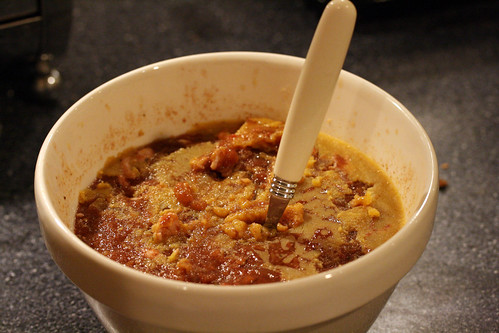
Your first task is to strain the liquid. I was amazed when I removed the container from the fridge. The liquid had set so solidly that it was able to support the weight of a spoon! Heat it first to turn it into a liquid and then pass it through a colander to remove the bacon, celery and onions and then force it though a fine sieve. Then reduce this liquid whilst you make your pasta. It will turn into the most syrupy, glossy sauce you can possibly imagine.

Then, layer the bottom of a cast iron pan with the solids that you have removed from the liquid. Then refry your cheeks in oil and butter until they take on a deep brown colour. Then place them in the cast iron pan. Fry the mushrooms in the pan that has just been graced by the cheeks, add a touch more cognac and then add them on top of the cheeks. Cover in foil and place in the oven to heat through along with the tomatoes in a separate pan which have been coated in olive oil and salt.

Now it’s time to make your pasta. It’s quite simple. Sieve 200 grams of pasta flour and add two large eggs and a pinch of salt. Knead this until it forms a non sticky dough. This will take about 15 minutes of sweat and wrist pain.

Wrap in clingfilm and let it rest in the fridge for up to an hour. Then sprinkle a large, clean work area in flour and roll out your pasta into thin sheets. Normally I’d use my pasta maker but I didn’t have it to hand. Without the machine it was seriously hard work. Cowie and I took it in turns to pulverise the pasta into ravioli thickness. Once it becomes around 1mm thick (or more accurately thin) trim the edges and hang up to dry for 10 minutes. Then cut into neat squares.

Bring a large pan of salted water to the boil and then add the pasta. It will cook in around 2 minutes. So make sure you’ve got your sauce reduced, the meat resting and the roasted tomatoes to hand. Ensure your guests are seated with a large glass of Italian red wine.

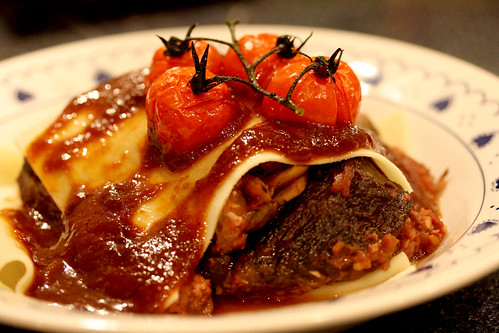
Add a square of pasta to the bottom of the bowl. Then a layer of ox cheek and some sauce. Then another layer of pasta. Then a spoonful of glossy sauce. And then a few tomatoes on top. Then a liberal sprinkling of parmesan and a turn or two of black pepper. Then serve.

The pasta was perfect. But the star was undoubtedly the quiveringly tender cheeks which almost shouted with flavour and swooned under the glossy sheen of the deep, dark sauce. The tomatoes added a burst of sweetness and the three year old parmesan from La Fromagerie added a grainy, creamy salinity and umami punch. It’s always hard to comment on a dish you’ve invented and made yourself… but it was awesome.

Ox Cheek Ravioli

The open ravioli technique worked brilliantly, behaving a bit like lasagne, or a pasta sandwich! But next time I’d like to make tortelli or ravioli properly having been inspired by Gastro1. They just look a bit fiddly and have a tendency to leak water. But I will do my best to conquer them.

Louis from Spilt Wine suggests drinking 2007 Mus ‘T’ red from Domaine de la Graveirette with this dish.

Further reading:

Dos Hermanos has got a great recipe for Beef Rendang that would work brilliantly with ox cheeks
The British Larder has a great post about a dish from Sat Bains featuring ox cheeks and oysters
New York Times with Mario Batali on ox cheeks
Waitrose "Forgotten Cuts" forum
eGullet on ox cheeks

Friday, 22 January 2010

Pigs Cheek Sausage Rolls & my Dream Pub Food

This is a more fuss free version of the Piggy Cheeky Wellingtons I made.

Pig cheeks in tray

Pig cheeks after cooking

Cook your pigs cheeks the same way by gently cooking overnight in a low oven. Let them cool then trim them lengthways so they are thinner and more suitable for sausage rolls.

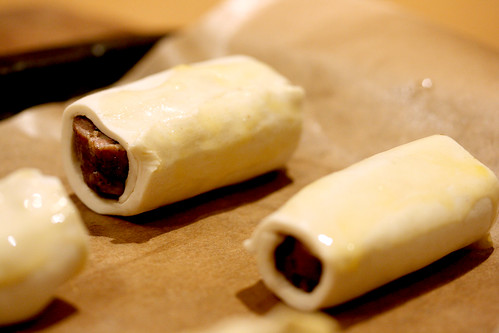
Pig cheek sausage rolls

Sausage rolls

Give them a little smear of mustard and then wrap them in puff pastry. Bake for 15 minutes until the pastry is browned and serve with some mustard and a pint of beer.

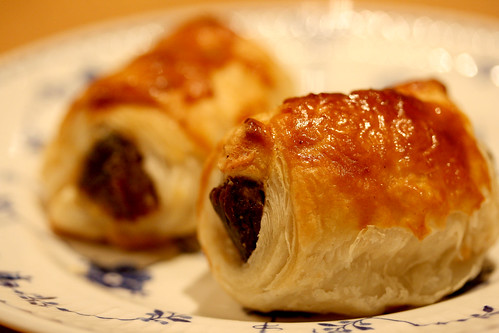
Pig Cheek Sausage Roll

The meat melted and the pastry crunched. They are cheap. Delicious. Easy. And divine. Without question, these are the best sausage rolls ever - Ginger Pig included.

Just thinking about pig cheek sausage rolls has made me want to own a pub specialising in serving imaginative bar snacks that use cheap bits of meat. We’d have Scotch eggs on a par with the Harwood Arms, pork pies that make Helen’s look average and pigs cheek sausage rolls that make you wonder why you ever visited the Ginger Pig. And all for a couple of quid.

We’d also make biltong from ox cheek and serve chitterlings to unsuspecting drinkers. Imagine how tasty chicken oysters would be encased in a thin dumpling? And the bliss of tucking into a platter of bourbon glazed short ribs. Ramekins of hare pate would be a doddle. Pork belly confit would be a favourite. Just thinking about deep fried skate knobs makes me feel weak at the knees, ankles and toes.

And what’s wrong with doing a range of larger more tapasy type dishes of pigs cheeks in cider and cream? Or slices of slow cooked ox cheek with smoky mash?

If you’ve got any ideas for imaginative pub bar snacks let me know and we’ll start a pub together!

Tuesday, 19 January 2010

Cheeky Pig Wellington

After almost tripping over myself in excitement when I first cooked pigs cheeks in a bourbon and mustard glaze, I’ve been gagging to cook with them again. I love their sweet tenderness and strong piggy taste. And the fact that they cost 14 pence each doesn’t hurt either!

Whenever I see them in Waitrose with the little green “Forgotten Cuts” flag in them I always buy the lot. Sorry. I just can’t help myself. This is probably why you rarely find them. It’s because a few annoying gits like me always gazump them.

A dozen or so have been in Cowie’s parents’s freezer for a few months now. And with a whole weekend to play with I decided to do something special with them. Cowie and I have been discussing how to cook them so much that Cowie has been plagued by bad dreams about being attacked by evil cheekless pigs! So when I flipped through a food magazine and saw a recipe for “Beef Wellington” the penny dropped and I started sketching out my recipe. I decided to switch the mushrooms in the traditional duxelle for apricots and then bolster it up with some pig’s liver pate. See below for the recipe. I then did a quick google and didn’t get any direct hits – does that mean this recipe is a world first?

Wash and pat dry you pigs’ cheeks. Then season them generously with salt and pepper before colouring them in a hot pan. Try to avoid smoking your girlfriend’s parents’ kitchen out at midnight like I did. Then sling them into a roasting dish along with a few sage leaves and whatever booze you have to hand. I used a glass of Argentine Pinot Noir. Then put cover with foil and cook very, very slowly. I put them in the top left oven of the Aga which is normally used for plate warming and let them bubble away overnight. But if you haven’t got an Aga and are worried about leaving the oven on overnight then slow cook them for 3 or 4 hours on a very low setting.

Pig cheeks in tray

Pig cheeks after cooking

Allow the pigs cheeks to cool and separate them from the juices.

Livery mix

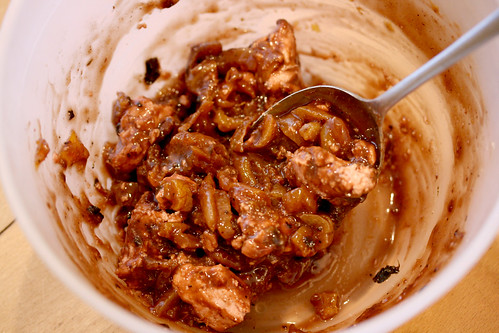
Reduce the liquid to a syrup and add a handful of chopped dried apricots. This will become a sticky brown goo that will form the basis of the “duxelle”. Add 100 grams of pork liver pate to the brown goo and mix so that it becomes a paste. Season to taste.

Pig cheek being wrapped

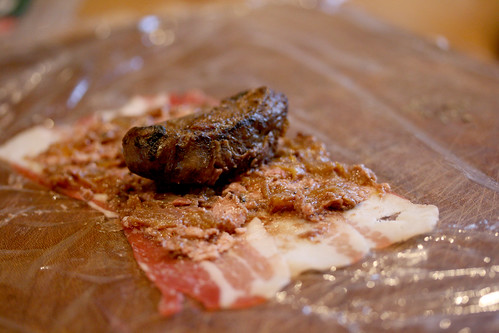
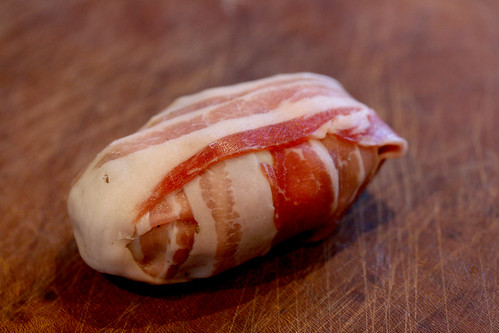
Then lay a piece of cling film on a chopping board or work surface and line it with three overlapping slices of pancetta. Smear them with the “duxelle” and plop a pigs cheek in the middle. Then wrap them up into smart little parcels.

Pig cheek parcel solo

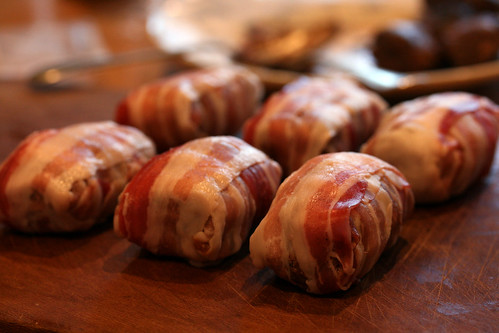
I then used an extra rasher of pancetta to hold it all together laterally.

Pig cheek parcels ready

Put these in the fridge and chill until you get around to rolling the pastry which must be done at the last possible moment to avoid soggyness.

Pig cheek wellington ready for baking

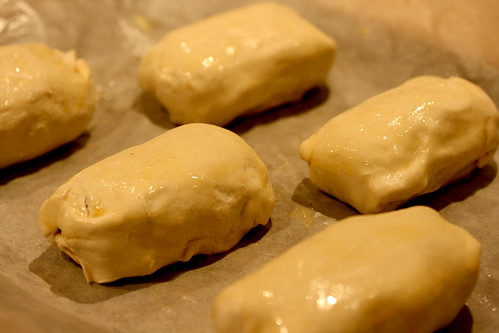
With 40 minutes to go before you want to eat them, roll out you puff pastry and roll it around the parcels. Place on a greased baking tray and cook in a hot oven until the pastry has browned which will take around 20 minutes.

Pig cheek wellingtons ta dar

Pig cheek wellington side

Pig cheek wellington cross section 2

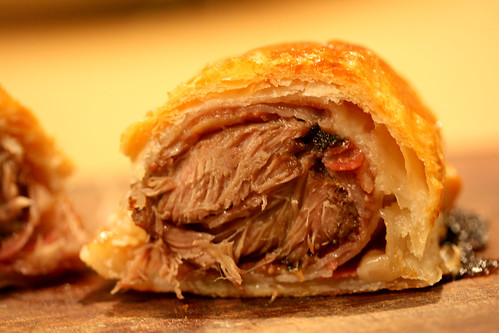
Serve to impressed guests with mashed potato, broccoli and mustard. The meat was more tender than anything I've ever eaten and the pastry was puffy and crisp. The apricot duxelle gave the pork a playful fruitiness that helped to take your mind off the richness of the pate and unctuous meat.

Who needs fillet of beef that costs and arm and a leg when you can create something that tastes much better and costs a pittance? If beef short ribs were the trendy cheap cut of 2007, lamb shanks in 2008 and pork belly in 2009, then I reckon 2010 is the year of the pig cheek.

LinkWithin

Blog Widget by LinkWithin