Showing posts with label cheese. Show all posts

Monday, 18 June 2012

Brunost and Juniper Venison Shank with Spelt

Venison shank-3

One of the classic ways of cooking with brunost in Scandinavia is to use it to enrich slow cooked game dishes that have been laced with juniper. I first discovered it in Andreas Viestad’s Scandinavian cookbook, Kitchen of Light. The sweetness and unexpected tang help to lift the sauce away from fuggy earthiness and gives the sometimes thin liquor a glossy glow. It’s the Norwegian equivalent of adding some dark chocolate to a Mexican mole.

I picked up a handsome venison shank from Balham Farmers’ Market that would have been just as happy (and a lot more expensive) had I encountered it in Gothenburg. The meat was as dense as lead and spoke of a life of permanent effort and back-breakingly hard work.

It needed to be cooked as slowly as possible – in a way that could cope with the rich flavour of the meat and the tense meat. So I decided to throw mushrooms, red wine, spelt, juniper and onions at the casserole dish and abandoned it for the afternoon whilst it burbled away in the oven. Whilst June isn’t the normal time of year to be writing about venison shank stews – the weather right now is making me feel a bit like hibernating with a lump of brunost.

Ingredients to serve 2

1 large venison shank or 2 small shanks
100g of pearled spelt
100g of dried mushrooms (preferably porcini or morels)
100g of sliced button mushrooms
30g of brunost
A good handful of juniper berries
2 bay leaves
2 onions
2 cloves of garlic
400ml of stock to cover (but top up with water as required)
2 glasses of red wine
Salt and pepper

Rehydrate the dried mushrooms and make sure you keep the liquor.

Method:

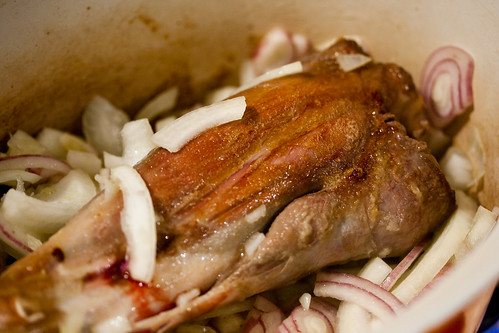
Roll the venison shank in seasoned flour and then brown in a hot cast iron casserole dish. Remove and then sweat the onion, button mushrooms and garlic until they have taken on some colour and the mushrooms have shed some of their juice. Then add the spelt, rehydrated mushrooms (and their liquor), the juniper berries, bay leaf and venison shank. Cover with red wine and stock until well covered. Then bring to a simmer.

Once it is bubbling away, pop on the lid and place in the oven to cook for another 2 hours or so at a low heat. You must check on its progress to make sure it doesn’t dry out as the spelt with absorb a surprising amount of liquid. Top up with stock, red wine or water as you wish.
Venison shank-1

Once the meat is lethargically giving up its grip on the tendons and bones remove from the oven and drain off the liquid. Strain these luscious juices into a pan and reduce to a condensed slick of brown heaven. Check for seasoning and add more juniper berries. Then when it is getting a bit thicker, add the brunost and whisk like a madman. The sauce should thicken and become a bit fudgy. Taste it as you go and don’t over reduce because the sugars may catch. Keep this warm whilst you attend to your cauliflower cheese.
Venison shank-5

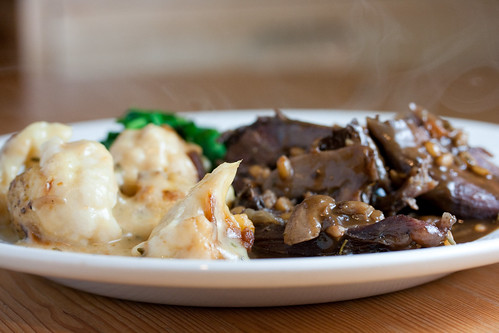
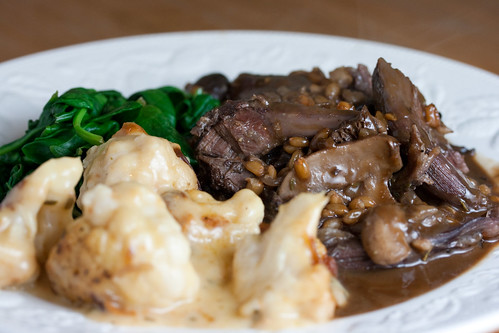
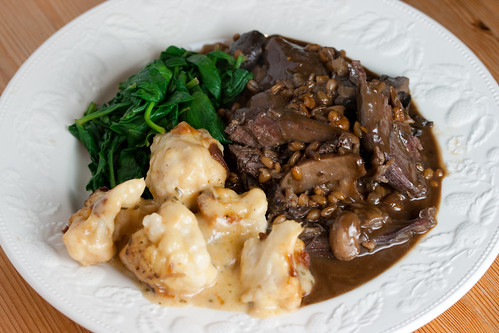
Strip the tender venison meat from the bone and assemble with the spelt and mushroom stew, topped with the glossy brunost and juniper sauce, alongside the brunost cauliflower cheese and some wilted spinach.

Like still waters, this dish runs deep. The combination of sweet and sour brunost with bitter juniper mixed with the feral depth of the mushrooms and venison make this a dish that a Viking, returning from a day of pillaging, would be very happy to come home to.
Venison shank-6

Tuesday, 3 April 2012

Liver with Brunost Cauliflower Cheese

Brunost Liver and Cauliflower

Brunost (AKA Gjetost or Gudbrandsdalsost) is an amazing substance. It’s a Norwegian cheese that is typically made by mixing goat’s whey with goat’s cream and reducing it down until you get a dense, fudgy, sweet and savoury caremlised cheese that’s really hard to pin down. All Norwegians have a block or tube of it in their fridge which they eat on crackers and other snacks. It was considered healthy because of the high iron content, but it has since been downgraded to a health risk because of the high fat content.

It packs more calories than any other cheese, leaving even the mighty Parmesan in its wake. It’s like a cheesy Daim bar that has a powerful tang.

I first encountered it in Gothenburg when the 6 foot blond Swedish girl with an Irish accent on the cheese counter in the local market gave me a nibble of it and explained that people often lob a bit into the pan juices when they cook a steak or game to make a rich gravy. I gave it a pass at the time, but half a year later had a sudden hankering to try it out.

I asked a few Scandi friends who pointed me in the direction of a few recipes that suggest mixing a small amount with meat juices when cooking steak, elk, moose or venison. I figured that a nice piece of calf’s liver would be just as good and decided to accompany it with a rich Norwegian take on cauliflower cheese that was spiked with fudgy brunost.

Brunost Cauliflower Cheese

Ingredients:

1 head of cauliflower
1 knob of butter
1 tablespoon of flour
100g of gruyere
30g of brunost
150ml of stock or white wine
150ml of milk
Salt and pepper

Method:

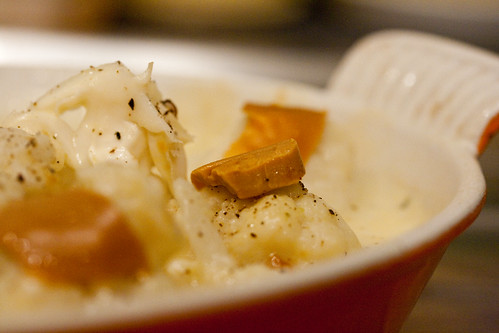
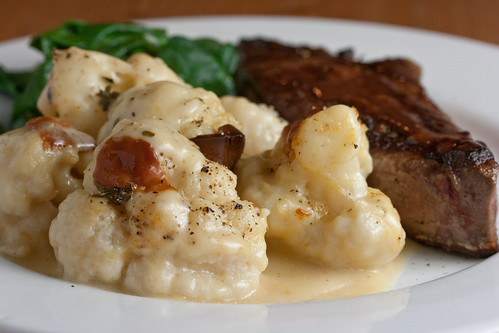
Basically, make cauliflower cheese as you normally would by blanching some cauliflower and then smothering in a cheesy, béchamel based sauce, topped with grated brunost.

I like to mix the milk half and half with stock and find that gruyere is an ideal cheese. But what makes this special is the addition of brunost which gives the cauliflower cheese a sweet and sour kick that works brilliantly with the liver.

Brunost Liver and Cauliflower

Simply grate the brunost over the cauliflower cheese and add a few lumps as well as you see fit. Season with salt and pepper and then throw it in the oven for 20 minutes until golden brown.

Then season the liver with salt and pepper, dust with flour and then sear in a very hot pan for a few minutes until the outside is browned and the inside is still pink. Allow to rest somewhere warm and in the meantime deglaze the pan with a spash of red wine. Then whisk in a knob of brunost and reduce until you have a thick, fudgy gravy. Taste as you go and adjust the seasoning.

Brunost Liver and Cauliflower

Serve the liver adorned with brunost sauce and flanked by cauliflower cheese and spinach. For wine pairings for brunost dishes, check out Snooth, but you might be better with beer.

Saturday, 28 January 2012

Smoky Somerset Horsebit


When we woke up we could see our breath billow out of our mouths as if we’d swallowed a smoke machine. Our bedroom windows were so cold they had silvery ice on both sides. And the horses in the stables looked out past icicles. The clear sky had invited the frost to paint its early morning picture and had left the grass twinkling in the light and crackling underfoot. At times like this winter is my favourite season.

After a bowl of raisin strewn porridge and some super-strong coffee I set off for a bike ride around the exhaustingly beautiful Somerset hills as part of my training for July’s Antwerp Half Iron Man. On days like this, cycling for a few hours in the clear English countryside air is a joy rather than a chore.

After forty or so miles I was almost home and treated myself to a trip to Lagan’s Farm Shop where I picked up some vintage smoked Somerset cheddar before buying a rye sourdough loaf from the excellent bakery At the Chapel in Bruton.

On my final few miles, as my fingers started to go numb as I passed the local hunt charging around on their horses, I tossed aside the thought of a simple ploughman’s and decided instead, to give the humble Welsh Rarebit a Somerset twist. With the combination of gooey smoked cheese, morcilla, horseradish, mustard, an egg and good bread, this was so much more than just cheese on toast. This was a Smoky Somerset Horsebit.

Ingredients:

2 thick slices of sourdough rye bread
200g of smoked cheddar
1 egg
1 dessert spoon of horseradish cream
1 teaspoon of strong mustard
Some crumbled smoked sausage (such as morcilla or chorizo)

Method:

Cut the bread thickly and toast.

Grate the cheese and mix together with the egg. Stir the horseradish cream, mustard and crumbled sausage into the cheesy-egg mixture and slather on top of the toast.

Grill for 5 minutes until the cheese has melted is starting to brown.

Serve with some chutney and a cup of tea.

The smokiness of the cheese and the horseradish elevate this from being just cheese on toast, to being something that you’d happily cycle all morning for. And the horseradish is a great way of jolting your body and mind back into life. The morcilla is optional, but it does help to make this a bit richer and more satisfying.

LinkWithin

Blog Widget by LinkWithin