Showing posts with label fish. Show all posts

Saturday, 27 October 2012

Roast Gurnard with sage and squash

Gurnard and Pumpkin

When we were in Salcombe a few years ago we went on a memorable fishing trip where I managed to catch nothing but sand eels whilst the rest of the gang reeled in a whole school of mackerel. A friend called Nick, who could catch a sea bass in a 2 inch puddle, even managed to snare a gurnard much to my shame. But then again he is a fish magnet.

In contrast to my sand eels, and the mercury coloured mackerel bullets, the gurnard seemed exotic and of another world. With big eyes and a red mohican it looked worryingly like the three eyed fish that is found in the river near the nuclear power plant in the Simpsons. Ever since this encounter I’ve been keen to cook one.

My chance belated came the other day. I popped into Moxons on my way home, in search of a modest piece of fish. I was thinking of lemon sole, Arctic char or mackerel, but was seduced by the idea of a large gurnard.

When I inquired how to cook it the fishmonger instantly dictated that I roast it with sage and pumpkin. I could have spent ages thinking about what would have worked well. But sometimes a bit of firm direction works wonders. On a hot summer night you’d probably be better with something more lemony and acidic, but if it’s a bit cooler this is a great way to enhance the earthy and mellow nature of gurnard.

Ingredients

1 large gurnard
½ butternut squash
Handful of sage
Spinach leaves
Salt
Pepper
1 lemon
Olive oil
3 cloves of garlic
Butter

Method

Cut the squash into bit sized chunks. Season with salt and pepper and roast in a medium oven along with the garlic cloves and sage leaves.

Make a garlic and sage butter by adding minced garlic with finely chopped sage leaves.

Prepare the gurnard by slashing the skin, seasoning and studding with sage butter.

After 30 minutes when the squash is getting soft, place your gurnard on top of the squash.

Cook for 10 minutes until the fish is just cooked. Remove from the oven and wilt some spinach in a pan.

Serve the gurnard whole, with the squash and spinach on the side. Squeeze some lemon over the fish and spoon whatever juices are left in the pan over the fish.

Gurnard and Pumpkin

Wednesday, 5 September 2012

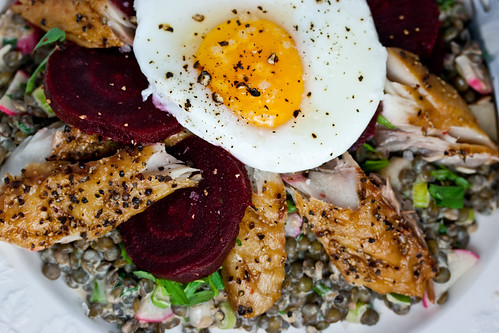
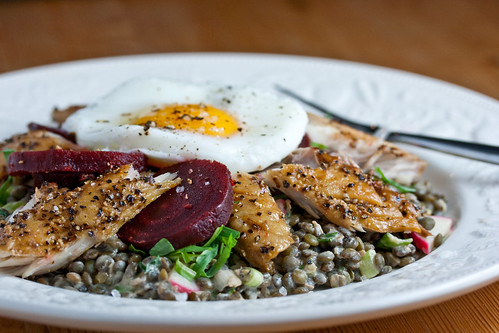
Mackerel, Beetroot, Lentil and Egg Salad

Lentil and Mackerel Salad-5

A few months ago I found myself arriving at a bizarre Parisian hotel in the middle of what seemed like nowhere for a meeting about biscuits. It was midnight. I was shattered. And the Hotel Mama Shelter flummoxed me so much that I landed up going to the loo in the ladies toilets – only to be ticked off by a couple of outraged lesbians.

After failing to find refuge in my concrete bedroom, lit only by and Obelix and evil Elvis masks, I decided to make a late trip to the bar to regain my sanity.


I whiled away an hour watching the “Medi-arty” hop from table to table, sipping, slurping and flirting in equal measure. The highlight was watching, a bombastically trendy Swedish teenager managed to chat up and bed a fawning American model all in the space of 45 minutes.

During lunch the next day we were served one of the best things I’ve eaten this year. It couldn’t have been a lot more simple. It was just a mound of perfectly cooked and seasoned green lentils, dressed with mustard and crème fraiche and topped with a soft boiled egg and a scattering of tarragon. Its simplicity belied its flavour and moreishness.

I’ve since taken this straightforward approach to lentils and cook this dish whenever we need to conjour a quick supper out of thin air. Add some smoked mackerel and beetroot and you’ve got one of the healthiest, easiest and most delicious suppers imaginable. I suspect it would be even better with some horseradish.

Ingredients for two people:

300g green lentils
2 eggs
Handful of chopped tarragon
3 smoked mackerel fillets
2 sliced beetroots
2 spoons of Dijon mustard
2 spoons of crème fraiche
Salt and pepper
Lemon

Method:

Boil the lentils until tender. Drain. And allow to cool slightly. Mix through the mustard, crème fraiche and most of the chopped tarragon. Season with salt and pepper to taste. 

Soft boil or poach your eggs.

Throw on some broken up pieces of smoked mackerel and some slices of beetroot and place the soft cooked egg on top. Sprinkle the remaining tarragon on top. Season the egg, squeeze some lemon over the top and serve immediately. Pierce the egg to release the runny yolk and tuck in.

Lentil and Mackerel Salad-1

Thursday, 29 March 2012

Hake a la Washing Machine

Washing Machine Hake-10

When our washing machine broke down, Cowie was spinning with rage, whilst I grinned to myself and said a quiet prayer to the Gods of domestic appliances, that it might be in a cookable state. I figured that if we had to buy a replacement, my lifelong ambition to cook in a washing machine would be within my grasp.

The engineer’s report indicated that the machine was in a fully functioning state, except that the drum just wouldn’t spin, so he advised us to get a replacement. I figured that this is the dream situation. I checked the internet to see if anyone had done anything like this before and discovered some Americans had, quite brilliantly, attempted to cook scrambled eggs inside whoopee cushions, with highly questionable results. I’ll leave you to ponder what talcum powder-cum-rubbery scrambled eggs would taste like.

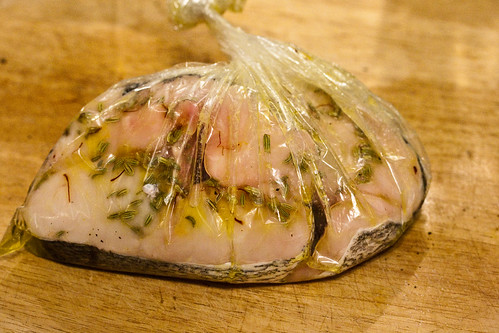
When we’ve cooked in lateral ways in the past, we’ve found a sure-fire technique is to improvise a sous vide bag by using a Baco bag and simply throw in a fillet of fish along with some flavours before doing up the bag with an aggressive knot. This approach was a great success when we cooked a fillet of salmon with soy, ginger, chilli and garlic in the dishwasher and the bath.

I popped into Moxon’s on my way home and had one of the most surreal experiences I’ve had in a long time. As I was perusing the selection of fish looking for some hake, one of the fishmongers inquired what I was looking for. Rather absentmindedly, I explained that I was looking for the ideal fish to cook in the washing machine. Silence descended before the boss intervened and asked his colleague to see if they had any hake behind the counter. Luckily they did and I was sent on my way with the fishmongers wondering whether they should call the asylum.

I figured that hake steaks would work well because the bones would support the structure and help them to cook evenly. Also, hake’s firm flesh lends itself to this long and slow cooking method. Rather than the Asian approach, used in the bath and dishwasher, I thought a combination of fennel and saffron would make for an exotic change.

Washing Machine Hake-2

Washing Machine Hake-5

When it came to the big night we popped the fish in a Baco bag along with some fennel seeds, salt, pepper, a dash of olive oil and a few strands of saffron and then set the washing machine on a 90’C cycle.

The machine gushed with water and then started to fill up, with the little parcel gently bobbing in the hot water bath. We sat and watched as the drum thankfully refused to spin and the fish gently cooked. It's an odd sensation having your food locked away without being able to prod or check it.

Washing Machine Hake-6

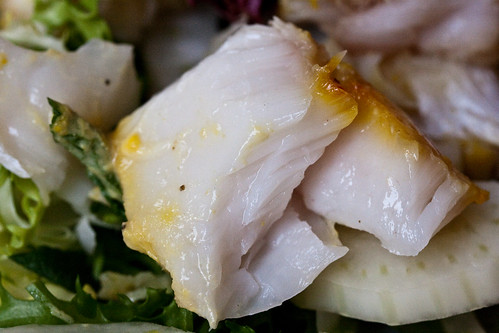
An hour or so later, the door clicked and we were left with perfectly cooked fish, that delicately flaked with a pearly gloss that held together like an MI5 officer under enemy questioning. The only down side was that because I’d put two fillets in the same bag, one of the steaks had slightly distorted into a strange shape. So if you are doing this, use separate bags.

I made a quick dressing by heating the juices that collected in the bag with a touch of cream and a squeeze of lemon and then made a salad with mint and fennel. The salad showed off the pearly white flesh and saffron hued surface whilst the fennel and mint added some crunch and freshness.

Washing Machine Hake-11

Washing Machine Hake-13

I couldn’t believe how well this crazy little project turned out. I was worried that the fish would be overcooked or uncooked. I was really concerned it would just taste of washing powder. And I wasn’t sure if the drum would kick in and start spinning at random. But none of these things happened and it not only worked perfectly, but it cooked the hake better than I have ever managed using conventional methods!

So when you hear the death rattle from your washing machine, embrace it and send it off to white goods heaven with a decent final meal.

Sunday, 16 October 2011

The Gurnard’s Head - Revisited

Gurnards Head from a distance

We had one of our favourite meals of all time at Gurnard’s Head back in 2009. It was only a light lunch of fish soup and grilled fish, but it was so perfect in its charm and flavour soaked simplicity that we left craving more. Inspired by our Cornish epiphany we went to The Gurnard’s Head’s sister pub in the Brecon Beacons called the Felin Fach Griffin and had an experience that was almost as good – it just made us want to return to the mother ship for more.

The Gurnard’s Head Inn is beyond St. Ives, not far from Land’s End and set back from a stunning stretch of Atlantic coastline. So it isn’t a place you can just pop along to on a whim. You need to build an entire holiday around it. So we decided to splash out on food rather than a roof over our head and found ourselves in Noongalllas's enchanting field between Penzance and St. Ives - where you rise from your tent to the sound of cows and the sight of a VW camper van selling coffee and croissants and go to sleep the sound of dropping pins.

We wanted to experience as much Gurnard’s Head goodness as possible so we walked down the National Trust coastal path with a picnic to explore the scenery. It turns out that The Gurnard’s Head itself is a rocky outcrop that stretches out into the Atlantic in the shape of a fish head, sheltering Treen Cove from the often ferocious sea. It’s been described as “one of the most striking and beautiful promontories in Cornwall” and is worth a visit with or without the brilliance of the restaurant.

Gurnards Head-6

Gurnards Head-4

Gurnards Head-1

Gurnards Head-5

Gurnards Head-15

Gurnards Head-11

The simply perfect 360 view, the roasting heat of the south facing natural sun deck and the cool breeze from the sea makes this outcrop our favourite bit of geography in the UK. After a perfect picnic we headed back to our tent to tart ourselves up and returned ravenously to the Gurnard’s Head for dinner.

We arrived with high expectations and settled in for what turned out to be a memorable meal. Please excuse the grainy pictures and I hope I can do the food justice with a scattering of words.

Gurnards Head-24

Pigeon salad with game chips, lambs lettuce and a turbo charged berry gravy was Cowie’s idea of heaven. The flesh was pinker than a camp panther with Cowie’s only criticism being that she’d like to have it all over again.

Gurnards Head-22

My crispy pig’s ear salad with peas, pork belly and a sticky sauce is the kind of dish that excites you about the rest of the meal to come, like a shot of adrenaline before a rugby match – just as starters are supposed to. With a glass of dry sherry it ranks as my favourite starts to a meal of the year.

Gurnards Head-26

Cowie’s cod, which came with a mound of puréed beans, carmelised fennel and a waft of truffle, was epic. It was as if the chef had briefed a silk worm to create a cocoon for the fish to be cooked in. It’s rare to find fish cooked with this level of care and intelligence. The purée complemented the softness of the fish and the fennel’s distinct fronds mirrored the flaky nature of the flesh.

Gurnards Head-25

My hake with basil gnocchi and spinach was the best thing I’ve eaten all year. Crisp skin, flaking flesh and a rich fishy depth had me savouring each bite - whilst the gnocchi’s fondant texture and loud basil flavour added several layers to this sensual feast. I know I’m wanging on about this dish, but it was pretty good.

We shared some delicious ice cream for dessert and lingered over coffee to absorb the atmosphere and avoid retuning prematurely to our tent. We fell in love with a playful spaniel puppy that epitomised the pub’s bosom like atmosphere as he scampered between tables and rolled over to have his tummy rubbed. If I was forced to choose a final meal – there’s a fair chance that the Gurnard’s Head would be near the top of my list to rustle it up.

Saturday, 11 June 2011

Swedish Lobster Safari – A Wild Lobster Hunt

Lobster Safari-7

“Would you be interested in going on a lobster safari, Jonathan?”

This is probably the best question I’ve ever been asked in my whole life. It’s the sort of question that makes you want to walk out onto the street and hug people. The sort of question that makes you want to give every penny to charity. The sort of question that is overflowing with unfettered positivity.

I accepted the invitation from the lovely people at the West Coast of Sweden Tourism board quicker than you could say “hummer-bra”. Having enjoyed my experience on a Mussel Safari back in the Autumn along the idyllic West Coast, I wasn’t going to miss out.

After some cursory research and some energetic emailing it emerged that Sweden and Norway are renowned for being home to some of the world’s tastiest lobsters. Apparently the cold, deep waters encourage lobsters to grow at a glacial pace which makes them more flavoursome. The icy winter conditions and strict laws forbidding fishing for lobster during the summer spawning months makes them harder to catch. Given that food tastes better when it is more scarce, more expensive and when you have gone to more effort to catch it, it’s no surprise that Scandinavian lobster is so tasty.

We drove up the West Coast Highway to Strömstad where we caught a ferry to South Koster Island with the warning that the chilly April waters would mean that we would be lucky to actually catch any lobsters ourselves. The coastal scenery, as ever, was staggeringly beautiful. It’s worth visiting whether you are on a “Wild Lobster Chase” or not. Remote. Craggy. Elegiac. And a balance of soft and harsh textures that makes you realise why Scandinavians make such frustratingly natural designers. It’s not surprising that the Koster Islands, just a few miles from Norway, are both a protected nature reserve and a mecca for red and blue flagged yachts.

Lobster Safari-27

Lobster Safari-38

We arrived at our hotel in Ekenäs, to find rooms looking out over the mackerel hued sea and a small flotilla of charming staff who answered our excited cascade of questions about lobsters and ushered us towards some lunch to prepare ourselves for the high seas.

Lobster Safari-1

A very tender, but thin, beef stew with onions and potatoes was transformed by the addition of crème fraîche and gherkins. A rustic balance of creaminess, acidity, crunch, freshness and beefy depth.

Lobster Safari-2

More refined, although terribly photographed, was a “cooked to perfection” trout with a creamy roe sauce and braised greens. My fears that the trout had been overcooked couldn’t have been more wrong. The flesh Dita-von-Teesed away from the bone and the roe sauce added to the sensuality as it burst saltily in the mouth. Meanwhile, the cucumber and braised beans were so good that I’m going to insist on cucumber being cooked this way from now on.

Lobster Safari-15

With our loins girdled and our sea legs filled with ballast, we ventured down to the harbour to meet our Lobster Safari Ranger. Johan was everything you’ve imagined a Swedish captain to be: larger than life, grizzly, weathered, bearded and blessed with a sense of humour that twinkled brighter than a Catherine wheel.

With our expectations of catching lobsters set very low, we chugged out to inspect Johan’s 14 creels that had only been in the water for 3 days. The water was still so cold that areas had only just thawed, so the lobsters were still in hiding and not likely to have made the mistake of falling into our mackerel baited trap.

Johan and his assistant hauled in the first few pots, but to no avail. They weren’t just devoid of lobsters – they weren’t even filling up with seaweed! Sadly the story was no different than when we took over. I managed to net a starfish, but other than that it was more a case of checking to see if the pots were still in one piece.

Lobster Safari-12

Lobster Safari-11

Johan assured us that despite our pitiful haul, we’d still be in for a lobster treat for dinner. And with that reassuring message reverberating in our minds, I took over the wheel and guided us around the islands to enjoy the amazing scenery as Johan regaled us with tales about the fierce rivalry between North and South Koster. The animosity between the islands is so strong that Johan’s father from the south island, refused to step foot on the northerly rival which is seen as more developed despite having a population of no more than a few hundred. The islands’ history and folklore is almost entirely dominated by fishing.

We heard tales of one fisherman accidentally catching 10 tonnes of dogfish; of a crazy Scottish man who had invented a novel way to catch langoustine who is now farming snails for the Asian market; of prawns that glow in the dark; of mackerel schools that are denser than concrete; and of a lobster heist that saw 1million SEKs worth of shellfish being stolen from local creels that could become the plot for Ocean’s 14.

As we made our way back to the hotel’s pontoon, we marveled at the views which almost made up for the lack of lobster…

Lobster Safari-20

Craggy seafront of South Koster

Lobster Safari-22

Sea view towards South Koster

Lobster Safari-45

Classic harbour huts on North Koster Island

Lobster Safari-47

The chain ferry linking North and South Koster

Lobster Safari-28

Trio of houses in sunshine as we left the harbour

Lobster Safari-39

Trio of houses under cloud cover as we returned

Lobster Safari-30

Trio of houses in twilight before we went for dinner

The early April light licked the shores with golden beams one minute and cursed it with withering coldness the next. Whilst we hadn’t caught any lobsters, we had enjoyed a magical boat ride and got an exhilarating taste of what life is like on the Koster Islands. But as we prepared for dinner we worried that we’d be punished for our poor fishing performance by taking lobster off the menu. Luckily, our fears were unfounded. Johan had responded to our poor catch not by scuttling his boat or making us walk the plank, but by nabbing a couple of lobsters off a friendly fisherman.

Lobster Safari-31

To our delight our meal started with a magnificent cold boiled lobster from less than a mile away. Served with aioli and mayonnaise it was everything you want from the king of the sea. Rich, tender and imbued with the sort of salty depth that makes you want to regurgitate each mouthful to enjoy it all over again.

Lobster Safari-34

Lobster Safari-33

Next came a second lobster that had been removed from its armour, poached in butter and anointed with a sauce made reduced lobster bisque. It came with a piece of soft claw meat, some lavishly buttery mash and a scattering of beans. It was every bit as decadent to eat as it looks and sounds. The only way it could have tasted better would have been if we had caught them ourselves.

As we finished the evening with lashings of rum and whisky, we reflected on our lobster odyssey and drank our final dram with a warm feeling of deep satisfaction. If Carlsberg were to offer fishing trips, this is how they’d do them.

This trip took place on the 9th April, towards the end of the lobster season which finished on the last day of April. It was set up and funded by the wonderfully generous people at the West Coast of Sweden Tourist Board.

The lobster safari is part of a series of fishing safaris that they organise up and down the West Coast. They also do oyster, mussel, prawn and crayfish safaris which you can find out about here. The lobster season starts again in September.

Wednesday, 1 June 2011

Swedish Salmon Stroganoff

Salmon Stroganoff-2

Swedish food culture is hard to articulate – for it doesn’t follow an easily digestible narrative. At first glance it seems healthy and fishy, but the more you dig into it, the more intriguing it becomes. So far I’ve detected three strands that compete and overlap.

The first area is that of the Nordic Diet which I have written about a fair bit, which sees meat and heavy carbs replaced by root vegetables, fish and slow release grains. Whilst it might seem like all Swedes eat this way, that isn’t very close to the truth. The reality is a bit more stodgy.

The second is Sweden’s native food culture, which isn’t that far off the hearty fare we know and love in Britain. Rich stews, lashings of potatoes, creamy sauces and overcooked vegetables are part and parcel of the Swedish cuisine that is called Husmanskost, or in other words, rustic homecooking from yesteryear. Like in Britain, this traditional and heavy approach to cooking has taken a back seat as daughters failed to pick up skills they would have otherwise learnt at their mother’s apron strings. But it is now making a comeback with Leif Mannerström at the helm.

The third strand is the way that Sweden has imported and bastardised many dishes from elsewhere such as Kåldolmar, much in the same way that we have done so with Indian food in the UK and the Americans do with Mexican food. They also love to slap doner kebab on pizzas and cover them, cravenly in burger sauce. Interestignly, one of Sweden’s most popular dishes is Korv Stroganoff, which sees beef fillet replaced by sausage. I made the mistake of mocking someone’s sausage stroganoff at work, only to find out it’s a cultural classic – up there with pickled herring and meatballs. So I wondered, could I bastardise the bastard to create the most illegitimate lovechild Sweden has ever seen. What if I replaced the sausage, which replaced the beef, with fish?

And lo, Swedish Salmon Stroganoff was born. I switched the shallots for fennel; the mushroom soup for lobster bisque; the parsley for tarragon; and kept everything else the same.

Serves 6

Ingredients

6 salmon fillets with the skin on
500g of button mushrooms
500ml of shrimp stock (or if desperate a can of lobster bisque)
300g of crème fraiche
Tarragon
Parsley
3 fennel bulbs
1 can of mushroom soup
Fennel seeds
Olive oil
Salt and pepper
Lemon
Serve with roast courgettes and rice

Method

Slice the fennel up into slithers, season and sauté with the fennel seeds until soft. Then do the same with the mushrooms until cooked. Combine the two and then add the shrimp stock which you want to reduce by half. Once this has reduced, add the mushroom soup, tarragon, parsley and the crème fraiche.


Meanwhile, season the salmon fillets and sear the skin until crisp.


Then pour the fennel and mushroom sauce into a baking tray and position the salmon so that the skin sits clear of the liquid and bake in a medium-hot preheated oven for 10 minutes until the salmon is only just cooked.


Serve with rice, roast courgettes, a grating of lemon zest and a segment of lemon. Then garnish with parsley and tarragon and let everyone tuck in. It’s great with a glass of fresh white wine such as a Sauvignon Blanc or a dry German Riesling.

Thank you to Christian for the atmospheric action shots from a recent dinner party where this dish made its debut. And thanks you to Sofia, Magnus, Nina, Anna and Leah for being such fantastic guinea pigs. But most importantly thanks for persuading me not to call this dish “Laxanoff”!

Sunday, 8 May 2011

A Superior Swedish Shrimp Sandwich

Swedish Shrimp Sandwich-10

Piercingly clear air. Baskingly warm sunshine. An almost un-Scandinavian feeling of camaraderie. Smiling faces sipping coffee. Children let loose from their reins. Beseandled feet. The most enchanting day so far of 2011.

I rarely get a weekend to myself in Gothenburg. So when they pop up I tend to try to indulge in all the things I love about this city. After a stimulating swim and sauna I tend to head to the fish church to stock up on seafood for the week ahead.

I always have my eye out for something a bit different and today an array of corral red shrimps caught my eye. They made the standard prawns look beige by comparison. The fishmonger explained that they were Scandinavia’s version of the King Prawn (Kungsräkor), from the deep chilly waters off the West Coast of Sweden and Norway. He said that they aren’t much known about and have a more lobstery taste than standard prawns. Interestingly, they very proudly display their provenance – indicating that these were from the waters around Styrsö and were caught at a depth of 280 metres. For those of you who thought that prawns were prawns, think again. They take their shellfish so seriously over here that they don’t just tell you where they were from, but also how deep they were caught.

Feeling more than a little bit giddy about the thought of eating my Kungsräkor (King Prawns) I quickly decided that they would make the perfect jewels in a regal shrimp sandwich. I picked up some glasört (samphire) and then headed off to my favourite café and baker (Da Matteo) where I found an exquisite loaf of rye sourdough that seemed to weigh as much as an ingot of gold. A slurp of their amazing cappuccino and a naughty chocolate croissant restored my energy levels and sent me speeding back on my bike to my apartment.

I inspected my Swedish Shellfish bible by Leif Mannerström and found a recipe for Shrimp Sandwiches. I loosely followed his advice but broke two of his golden rules – I switched the homemade mayonnaise for crème fraiche and tossed aside his dictat to only ever consider using soft white bread. I also added samphire and avocado to make it more indulgent. But the rest of the recipe isn’t far off. And it Is in line with his simple, rustic and honest approach so I am sure he wouldn’t shot at me too much. And to appease him further I kept the shells as he implores and made them into an incredibly rich stock.

Ingredients:

500g of Kungsräkor with roe
3 slices of rye bread
3 tablespoons of crème fraiche
3 radishes
½ avocado
Wedge of lemon
Salad leaves
Handful of blanched samphire
Salt and pepper
Method

Method:

Peel the prawns and chuck the shells into the pan you’ll make your stock in later. Plop the roe into a separate bowl. It’s a bit fiddly because the shells are thinner and more clingy than normal prawns, but it’s quite therapeutic.

Swedish Shrimp Sandwich-2

Swedish Shrimp Sandwich-3

Swedish Shrimp Sandwich-6

Swedish Shrimp Sandwich-8

Slice the rye bread and smear with crème fraiche. Lay the samphire on top and then create a layer of prawns that look as though they are spooning each other. Arrange some salad leaves around the outside, lob on a few slices of avocado and radish. Then finish it off with a smattering of lemon and a gung ho scattering of salt and pepper. Then anoint with the crimson roe.

Swedish Shrimp Sandwich-9

Swedish Shrimp Sandwich-11

In Sweden you can barely move for shrimp sandwiches. But it's hard to find a really good one. Too often there's too much mayonnaise and the prawns are tasteless. But not so here. The rye sourdough added texture, sweetness and acidity which helped to make the special shrimps taste even more of themselves. And the radishes and samphire, inspired by our trip to Aamanns in Copenhagen, turned this from being a standard shrimp sandwich into a superior shrimp sandwich.

LinkWithin

Blog Widget by LinkWithin