Showing posts with label chicken. Show all posts

Friday, 18 March 2011

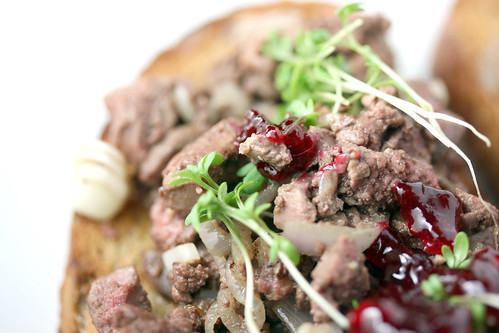
Chicken Livers on Toast with Lingonberry Jelly

Liver on toast side

Good food needn’t be fancy. It doesn’t have to be expensive. And a quickie can be as satisfying as a three hour gastronomic romp. Chicken livers are one of the cheapest morsels of protein available and are every bit as tasty as the rest of the chicken so long as you’re not eating them on a daily basis. At roughly a tenth of the cost of a chicken breast they’re amazing value that I am keen to take advantage of more often.

Apart from chicken liver pate, the only other recipe that has caught my attention has been Mark Hix’s chicken livers on toast – which only just qualifies as a recipe rather than a composition. But it’s bloody tasty. Especially if you go a bit off piste add a dollop of still warm super-rapido-lingonberry-jelly.

Ingredients

Handful of chicken livers, cleaned and roughly chopped
50g butter
1 big shallot or half an onion
1 small clove of garlic
Salt and pepper
Sourdough for toasting (I used a couple of slices of a great walnut sourdough)
Cress
Handful of frozen or fresh lingonberries
100ml water
Dollop of honey

Method

Bring the water to the boil and add the berries. When they have simmered and softened pass them through a sieve to remove the skins and pips. Then return to the pan and reduce to a syrup and add the honey as necessary to temper the tartness. It’s best to do this stage before you start with the livers. It doesn’t take long but it gives the syrup time to cool and jelly-ify.

Fry the shallot and garlic until soft. Then season the chopped and cleaned livers with plenty of salt and pepper and then fry in the butter for around 4–5 minutes until they are still pink but cooked.

Remove from the pan and then attack with your best cook’s knife until the mixture is finely chopped. Then taste for seasoning and adjust as necessary. Keep the livers warm whilst you make your toast.

Butter the toast and dollop the mixture on top. Sprinkle over some cress and dress with the lingonberry syrup which will probably have turned to a runny jelly by now. Grind over some pepper and sprinkle over some smoked salt and tuck in.

Liver on toast aerial

Liver close up

This recipe came from Mark Hix’s Oyster and Chop House book, which I will be taking inspiration from for a few posts in the near future. The lovely people at Quadrille sent it to me a while ago.

I’m keen to experiment with chicken livers and move beyond smearing them on toast, so if you’ve got any great ideas which don’t involve making it into a pate please let me know! If they are Scandinavian recipes you get a special mystery prize.

Sunday, 9 January 2011

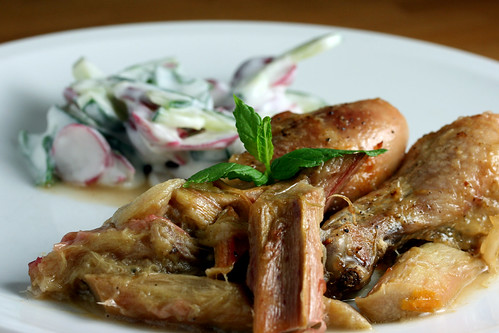
Chicken with Baked Rhubarb and Cucumber and Radish Salad

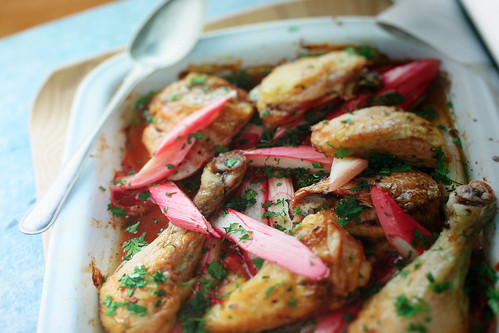
Chicken with rhubarb

I love the way rhubarb unfurls out of the spring soil to display a Mateus flushed shard of swollen stem and tough, poisonous leaves. I love the ritual of forcing rhubarb in darkened conditions to beat your neighbours to serving the first rhubarb of the season. I think back longingly of my grandmother’s hit or miss rhubarb fool that was always delicious, if a little stringy. And will almost always order a rhubarb dessert if I see it on the menu. Unfortunately, we don’t eat much rhubarb as a family because the acid gives us all joint ache. But it’s worth the discomfort.

Up until now I’d not thought too much about rhubarb (shocking I know). But the more I read, the more interesting it becomes. For starters who knew that rhubarb is actually a vegetable and is in the Rheum family and is therefore closely related to sorrel? Or that in America it is legally a fruit because a judge said so in 1947? Or that it originated in Asia and has only been cultivated in the western world for the last two or three hundred years? Or that the roots can be dried and used as a tonic to cure constipation and circulatory issues? Or, more importantly, that this enigmatic stem is amazing with chicken?

Trina Hahnemann’s recipe for “chicken with baked rhubarb and cucumber -radish salad” immediately stood out from her Nordic Diet cookbook, partly because of the stunning photograph but more significantly because of its weirdness.

Nordic Diet-4

But when you think about it, the idea makes a lot of sense. Chicken is great with lemon and other acid driven accompaniments, so long as it is balanced by something sweet to take the tartness away.

Ingredients

Chicken legs
2 stalks of rhubarb
A few spoons of honey (she uses raw sugar – but I prefer honey)
Salt
Pepper
1 Cucumber
10 Radishes
Yoghurt (preferably goats’)
1 clove of garlic
Chopped mint

Method

Season the chicken legs and roast for 30 minutes. Meanwhile chop the rhubarb into 2 inch long batons and lightly coat in honey. After 30 minutes add the rhubarb and cook for a further 15 minutes.

To make the salad finely slice the radishes and de-seed, then finely slice the cucumber. Mix with just enough yoghurt, a finely minced clove of garlic and the chopped mint. Season.

Serve the chicken with the salad and garnish with a sprig of mint. It’s a great way to use up a glut of rhubarb in late spring or as a way of causing a bit of Steingarten-esque debate about the differences between fruit and vegetables. I think it is a fantastic idea and am looking forward to experimenting further. I wonder what a rhubarb-ified version of honey lemon chicken would be like?

Further reading

Other rhubarb chicken recipes on Rhubarb Compendium including roast chicken stuffed with rhubarb and the psychopathically named chicken smothered in rhubarb

Rhubarb as an accompaniment to fish in the Independent

Mackerel with roasted rhubarb from Nigel Slater


Savoury recipes for rhubarb on Chowhound


Jeffrey Steingarten’s Man Who Ate Everything (including a spellbinding chapter called Ripeness is All about the differences between fruit and vegetables)

Trina Hahnemann’s – The Nordic Diet on Amazon


The science of rhubarb poisoning


This post is part of little series dedicated to The Nordic Diet cookbook which was sent to me by Quadrille.

Monday, 24 May 2010

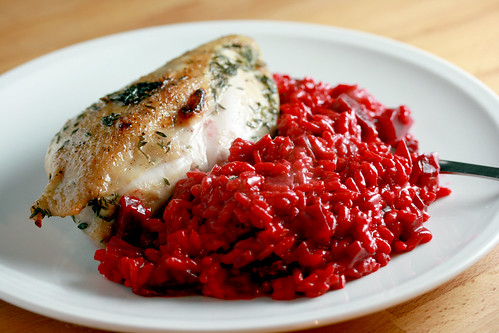
Salted Chicken with Scarlet Risotto

Salted chicken and beetroot risotto 3

I’ve settled into my flat in Gothenburg and took untold amounts of pleasure in unpacking all my kit that has arrived from the UK. Having lived without books and my kitchen kit for a month or so, the process of arranging my small library and kitchen was particularly satisfying. I now feel settled and ready to embrace everything that Sweden has to offer.

I’ve bought two Swedish cooking books to act as my culinary bibles – The Scandinavian Kitchen which is quite everyday and Aquavit for when you want to experiment.

I set off to the supermarket with the intention of cooking salted duck which I found in the Aquavit book. But when I could only find frozen “Anka” for 11 pounds a breast I decided a change of tack was in order. ICA Focus has a fantastic range of pork and beef. But if you want chicken, lamb or duck you’re in for disappointment. And even more so if you can’t understand the language. It makes it so hard to know what cut of meat you are looking at. Especially when they are butchered slightly differently to in the UK. I’m now determined to learn Swedish from a cooking perspective!

After 30 minutes of walking backwards and forward, in a mild state of panic, I selected a rather expensive, but very fine looking chicken breast from the organic section and decided to cure it in brine instead of the duck and to accompany it with a blazing red risotto stained with beetroot and sundried tomato. It was one of those spur of the moment about turns in a supermarket that transforms your mood from being a bit bleak to bouncing down the aisle to the checkout – eager to turn the hob on and get cooking.

Ingredients:


For the chicken

1 chicken breast
4 tablespoons of salt
2 tablespoons of sugar
Loads of thyme

For the scarlet risotto

1 beetroot
Risotto rice
3 sun dried tomatoes
Salt and pepper

Method

Make a brine by boiling a pan of water and dissolving the salt and sugar. Once boiled allow to cool and add the thyme. Then submerge your chicken breast and weigh it down with a bowl. Allow to cure for up to 12 hours. The brining process makes the meat very tender and juicy. And means that the skin will crisp up beautifully. It's a technique that pops up repeatedly in Scandinavian cooking.

In the meantime, dice a beetroot and add to a pan full of water. Boil for 20 minutes until tender. Drain the red water into another pan and reserve. This will be your stock.

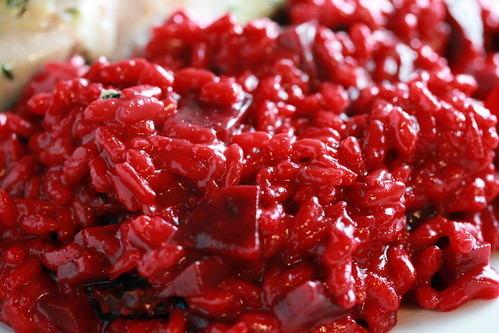
In a heavy bottomed pan sweat an onion in butter and olive oil. Then add the chopped beetroot and your rice. Allow to crackle in the fact and watch it turn red. Then add the stock bit by bit as normal and enjoy the experience of making one of the scariest looking risottos you can imagine. Cut your sun dried tomatoes into slithers and lob them in to. They will add a nice tartish note to the sweet and earthy rice. Once the stock has absorbed and the rice is cooked beat in a wad of butter and watch it turn glossy like a tin of Dulux paint.

Beetroot risotto close 2

Dry your chicken breast and coat in oil and a squeeze of lemon. Roast for 25 minutes.

Assemble and eat.

The earthy risotto is the perfect foil for the salted chicken which is moist and graced with crispy skin. As a combination it works like a dream and is a great conversation starter because it looks so strange!

Friday, 30 October 2009

Mole Poblano


With Day of the Dead upon us, what better thing to write about than my first ever attempt at cooking a mole. Those of you who still have nightmares about us eating ortolan, hare and squirrel needn’t duck behind the sofa. No. I’m talking about the Mexican sauce that is richly flavoured with chocolate and an array of chillies.

I had a look on Wikipedia to try to get my head around what a mole is. Apparently, “Mole can be best defined as a very thick, homogeneous sauce with complex flavors. This distinguishes it from most Mexican salsas which are watery, often raw, and contain fewer ingredients (usually nothing more than tomato, onion, garlic and chili pepper) in still-identifiable chunks.”

Naively I thought that mole was a dish in its own right. But it isn’t. Rather it’s a sauce that you use to pour over chicken, or use to smother an enchilada in. There are numerous regional versions with the most famous being from Puebla and almost as many stories and myths about where the concoction first originated. My favourite features a particularly well timed gust of wind. But sadly, none involve little mammals that burrow underground

Here’s how to make Mole Poblano

You will need:


1 Clean and orderly kitchen
1 Fully functioning extractor fan
1 Free afternoon
A sense of adventure
2 extra pairs of hands
1 Handful of chipotle chillies
1 Handful of dried ancho chillies
1 Handful of habanero chillies
Some Vegetable Oil
A few onions
A bulb of garlic
A couple of tomatoes
A Handful of nuts
A Handful of dried fruit
Teaspoon of allspice powder
4 cloves
A couple of star anise
½ stick cinnamon
A scattering of sesame seeds
A couple of corn tortillas
A smattering of oregano
A bar of dark chocolate
3 tbsp Demerara sugar
2 litres chicken stock
Salt and pepper
Chicken thighs and wings


Pop the onion in the oven along with garlic and tomatoes and give it a good roasting until the skin has begun to char. Set this aside and concentrate on the other stuff.

Skin and bone the chicken thighs. Reserve the lovely meat. Then make a proper stock from the chicken wings, thigh bones and skin. After an hour or two strain the liquid. Once cooled pick through the solids and salvage the meat from the wings – as you’ll add this to the mole later.

Grab your dried chillies and simmer them until they are soft. This dish depends on the correct layering of chilli flavours so you’ve got to get your hands on the right ones. All three types are important but it’s the chipotle that will make or break it. I’ve managed to find dried ancho, habanero and chipotle chillies in Brixton’s Tesco. (But if you don’t have such a fantastically stocked supermarket have a look at South Devon Chilli Company’s website.)Then, once they have softened put them to one side and move on to the nuts.

Fry the nuts in oil or lard to release their flavours. You want them to caramelise slightly and become super nutty. Remove them and add in the prunes and raisins so the kitchen starts to smell of a melting Fruit and Nut bar. Then fry the tortillas.

Fry the sesame seeds and then do the same with the allspice, cloves, star anise and cinnamon. Then make this into a paste using a spice grinder. By this time your kitchen should look like the Helmand Province.

Now amalgamate the softened chillies, fried fruit and nuts into a bowl, add some liquid and blitz. Then combine everything together and fry in a large pan for 5 minutes over a strong flame.

Then tip all of this into your slow cooker and add the roasted tomatoes, onions and garlic, 2 litres of chicken stock, the chicken thighs and wing meat, a bar of dark chocolate a handful or oregano, a few spoons of Demerara sugar and a sprinkling of salt and pepper.

Mole slow cooker

Allow this to bubble away for 5 hours or so. The finished mole is best left to mature overnight and then reheated the next day.

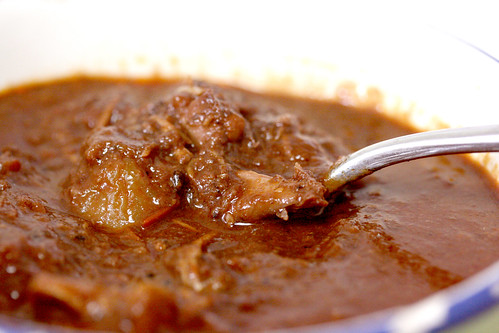
Mole in a bowl

The mole went down a storm at Cowie’s birthday party. No-one had tried it before, let alone made it. So they had nothing to compare it to. The chicken was moist and tender. And the spicing was fantastic. Although it was rammed for of chilli, the flavours were all layered. The chipotle gave it a smoky side, the ancho gave it a fruity dimension and the habanero delivered heat. The chocolate gave it a rich, dark sheen and the nuts and tortilla added thickness.

If you’ve got a spare Sunday and are keen to make a mess of your kitchen, then making a mole couldn’t be more ideal. You can freeze it and use it in countless way. I’ve now got the mole bug and am keen to learn more about how to cook Mexican food and use chillies properly.

Friday, 16 October 2009

Za’atar Chicken

Chicken

Za’atar is a middle eastern spice blend that I’ve recently developed quite a crush on. It’s dark green and is predominantly made from Thymbra spicata which is a slightly minty member of the oregano and thyme family. The blend is then made up of ground sumac, roasted sesame seeds and a variety of other green herbs. For full etymology and biblical references have a look at the Epicentre website.

Feeling bamboozled and not knowing quite what to do with it, but feeling adventurous and very much inspired by our Ottolenghi experiences recently, I decided to cobble together my own recipe for za’atar chicken to feed a dinner party of 10. If Nigella can do it, then so can I.

Here’s what to do…

Stir 5 large spoons of za’atar spice into enough olive oil to form a paste. Then add a dessertspoon of sumac and give it a taste. I’ve got to admit that my first impression was that I’d just created an oily, gritty mess. Not unlike mixing weed with lighter fuel. But I persevered. And encourage you to do the same.

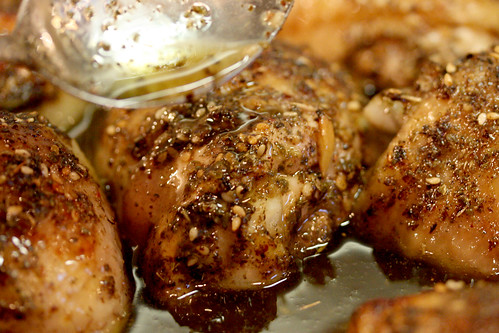
Smear your paste over 20 chicken thighs and season with salt. After a brief discussion with Cowie, I then poured over a glass or two of white wine and a squeeze of lemon to give it some moisture and acidity. The chicken then got whacked in the oven for an hour at about 180’c, whereupon, with a bit of basting and turning, it transformed like a latter day Britney Spears from looking apologetic, anaemic and bland into a moist, exotic, showstopper.

Remove the chicken from the baking dish and put it in a fresh dish into the now cooling oven so the skin stays crisp and the meat gets a chance to rest. Then, to create a sauce, pour off the liquid and separate out the fat. Add the remaining cooking liquid back into the baking tray you cooked it in and place it on a high heat on the hob and reduce as if there is no tomorrow. Add a glug or two of pomegranate molasses and some honey and adjust the acidity by squeezing in lemon until it thickens and tastes right. (This bit was seriously ad-libbed but it worked out a treat.) We were left with a sticky, syrupy, savoury, sensational sauce that I never dreamed of ending up with when we started.

Serve with Israeli cous cous, studded with pine nuts and raisins along with the ever-popular Ottolgenhi classic of scorched broccoli to appreciative friends.

It worked out brilliantly. Next time I’m going to give the same treatment to a whole chicken and serve it as a Sunday roast.

Despite this not being directly influenced by the Ottolenghi cookbook, it certainly played a key role in inspiring us to experiment with new ingredients such as sumac, za’atar and pomegranate molasses. But I’m getting worried that our growing Ottolenghi addiction may result in us booking flights (that we can’t afford) to Damascus, Cairo or Beirut to get stuck into Middle Easter food first hand.

Friday, 3 July 2009

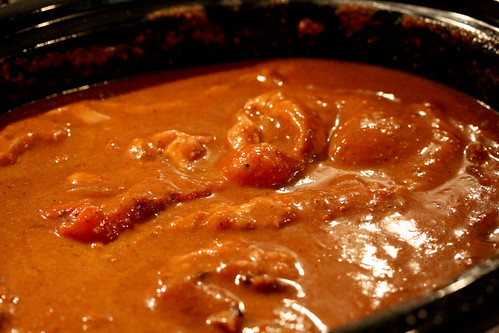
Tandoori Chicken

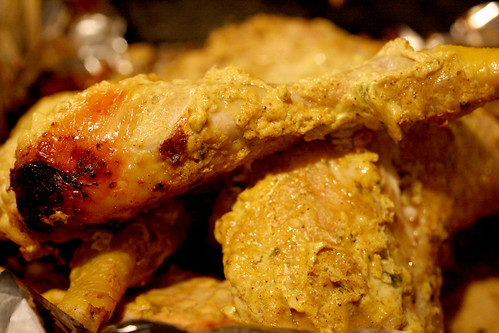
Every time we visit Cowie's parents is another excuse/opportunity to experiment with Cassius, our clay oven. It has excelled at cooking pizza and roast lamb so we thought we'd see how it coped with tandoori chicken.

We took inspiration from Madhur Jaffrey's recipe and just added more fire. The basic idea is to create a marinade from greek yoghurt, lime, garam masala, chilli, ginger, garlic and coriander. You blitz this together, add some salt and allow the marinade to tenderise the meat and penetrate the flesh with the Indian flavours. About 3 hours will do the trick, but over night is ever better.

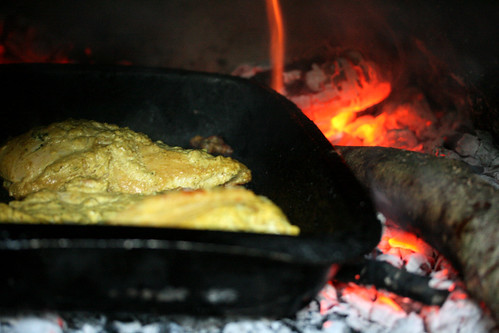
Given that we were catering for 10 we needed 3 chickens so we had to par-cook the legs and wings in the aga and blasted the breasts in the Cassius when he was at full heat. We've not been able to measure the temperature yet, but it is way hotter than any oven I've ever used.

The breasts cooked in about 15-20 minutes. They emerged with a charred, spicy crust and dripping with moisture inside. It's a great technique. It wasn't a bad result given that it was our first attempt. Next time I'm going to add more chilli to the marinade and make some naans.

Tandoori Chicken in oven

Tandoori chicken legs

What shall we cook in Cassius next?

Sunday, 20 January 2008

Roast Chicken followed by White Chocolate Bread and Butter Pudding

Mum and Suz cooked a delicious roast chicken for Sunday dinner. Stuffed with lemon and thyme it was tender, moist and beautifully brown. A joy to carve and very obviously free range/organic. You could tell by the taste and also by the texture of the skin. It just seemed like a bird with more integrity. Not like the battery chickens on Hugh's programme a week or so again.


Suz said that she has noticed a change in her local Tesco. Whereas there used to be a preference in store for cheap, battery chicken. Now people are shying away from the poor quality birds and are trading up to the free range option. This can be seen by the number of battery birds left on the shelf and the amount of space now given to free range chickens. I just hope this is the start of a movement that will be with us to stay and not just a flash in the pan.

We followed our chicken up with a similarly coloured dessert - a white chocolate brioche pudding with figs and orange which was stunning. There's something very special about these kind of meals. It's great to spend time as a family catching up and relaxing.


Wednesday, 9 January 2008

Chicken Out


I've been eagerly looking forward to seeing Hugh's Chciken Out programme on Channel 4 having become really intrigued by his chicken play pen we saw whilst mushroom foraging at the River Cottage. There were quite a few references throughout the day to Hugh's "Second Life" chickens. Not pixelated chickens in digital format but birds that he has taken out of the intensive system shown on his show and reared in peace and harmony. Just look at the fun you'd have in this little field!


Having only watched the two epsisodes so far it's very compelling stuff. I've always tried to buy free range eggs and chickens, mainly because they are tastier. I guess it's hard to always be able to afford it. If you decide that you can afford free range chicken then you're obliged to buy free range pork, bacon, sausages etc as well. I've not got much of a clue about pig farming but I have heard it is every bit as depressing as intensive chicken farming at its worst.

What struck me yesterday was how top heavy the intensive birds were. Toppling over because they were growin so much breast meat so quickly. The odd thing is that on the continent they much prefer leg meat and breed their birds the opposite way round. I wish we did that here. There's nothing quite like a tasty chicken leg.

This recipe for chicken leg confit looks delicious. Thanks to Brian Garthwaite


Well done Hugh for throwing his heart and soul into the plight of the UK's chicken. I can only hope that our supermarkets can find a solution. It's appalling that they won't even talk to Hugh on camera. But then again I can see their PR gurus going beserk about the possibility of being shown up by the UK's most idealistic cook. At the end of the day it's all about business.


Be sure to sign up to the campaign here. And be sure to watch Jamie Oliver's Fowl Dinners on Friday night on Channel 4.

LinkWithin

Blog Widget by LinkWithin